Audio/Video
A starting point for becoming familiar with audio and video in the Chromium projects.
Get Connected
Slack
For more real-time questions and collaboration, please consider joining the
#media slack channel.
See the main Chromium Slack page for rules and instructions on signing up, as well as tips and tricks.
Mailing Groups
For more serious technical discussions or topics with potentially broader interest, it's still best practice to send to the chromium-dev discussion group (chromium-dev@chromium.org) or, for media specific matters, the media-dev discussion group (media-dev@chromium.org).
See Technical Discussion Groups for an extensive list of available groups.
Issue Tracking
Issues are tracked in the Chromium > Internals > Media component. See the open issues query.
Documentation
The majority of the media documentation lives in the source tree, see
media/
For historical reference, here's the original
design doc for HTML5 audio/
Codec and Container Support
Chromium supports a variety of codecs and containers for content playback (decoding) and content capture (encoding), listed below.
Container formats
- MP4 (QuickTime/ MOV / ISO-BMFF / CMAF)
- Ogg
- WebM
- WAV
- Matroska
- HLS
Codec formats
Audio
- FLAC
- MP3
- Opus
- PCM 8-bit unsigned integer
- PCM 16-bit signed integer little endian
- PCM 32-bit float little endian
- PCM μ-law
- Vorbis
Proprietary Audio Codecs (Limited to Google Chrome)
- AAC (Main, LC, HE profiles only)
- xHE-AAC (requires native OS support, i.e. Android P+, macOS, Windows 11 22H2+)
Video
- AV1
- VP8
- VP9
Proprietary Video Codecs (Limited to Google Chrome)
- H.264 / AVC
- H.265 / HEVC (Proprietary, limited to Google Chrome, requires hardware support)
Code Locations
Chromium
-
media/- Home to all things media! -
media/audio- OS audio input/output abstractions -
media/video/capture- OS camera input abstraction -
media/video- software/hardware video decoder interfaces + implementations -
third_party/ffmpeg- Chromium's copy of FFmpeg -
third_party/libvpx- Chromium's copy of libvpx
Blink
-
third_party/blink/renderer/core/html/media/html_media_element.{cpp,h,idl}- media element base class -
third_party/blink/renderer/core/html/media/html_audio_element.{cpp,h,idl}- audio element implementation -
third_party/blink/renderer/core/html/media/html_video_element.{cpp,h,idl}- video element implementation
Particularly Interesting Bits
-
media/base/mime_util.cc- definescanPlayType()behaviour and file extension mapping -
third_party/blink/renderer/platform/media/multi_buffer_data_source.{cc,h}- Chromium's main implementation of DataSource for the media pipeline -
third_party/blink/renderer/platform/media/multi_buffer.{cc,h}- Implements the sliding window buffering strategy (see below) -
third_party/blink/public/platform/web_media_player.h- Blink's media player interface for providing HTML5 audio/video functionality -
third_party/blink/renderer/platform/media/web_media_player_impl.{cc,h}- Chromium's main implementation of WebMediaPlayer
How does everything get instantiated?
WebLocalFrameClient::CreateMediaPlayer()
is the Blink embedder API for creating a
WebMediaPlayer
and passing it back to Blink. Every HTML5 audio/WebMediaPlayer.
For Chromium this is handled in
RenderFrameImpl.
Build Configuration & GN Flags
Chromium currently uses the GN meta-build
system for generating build files. With several exceptions, the majority of
GN flags that alter the behavior of Chromium's HTML5 audio/
ffmpeg_branding
Overrides which version of FFmpeg to use.
- Default:
$(branding)- matches the build branding (see is_chrome_branded) - Values:
Chrome- includes additional proprietary codecs (MP3, etc..) for use with Google ChromeChromium- builds default set of codecs
proprietary_codecs
Alters the list of codecs Chromium claims to support, which affects <source>
and canPlayType() behavior.
- Default:
false - Values:
false-<source>andcanPlayType()assume the default set of codecstrue-<source>andcanPlayType()assume they support additional proprietary codecs
How buffering works
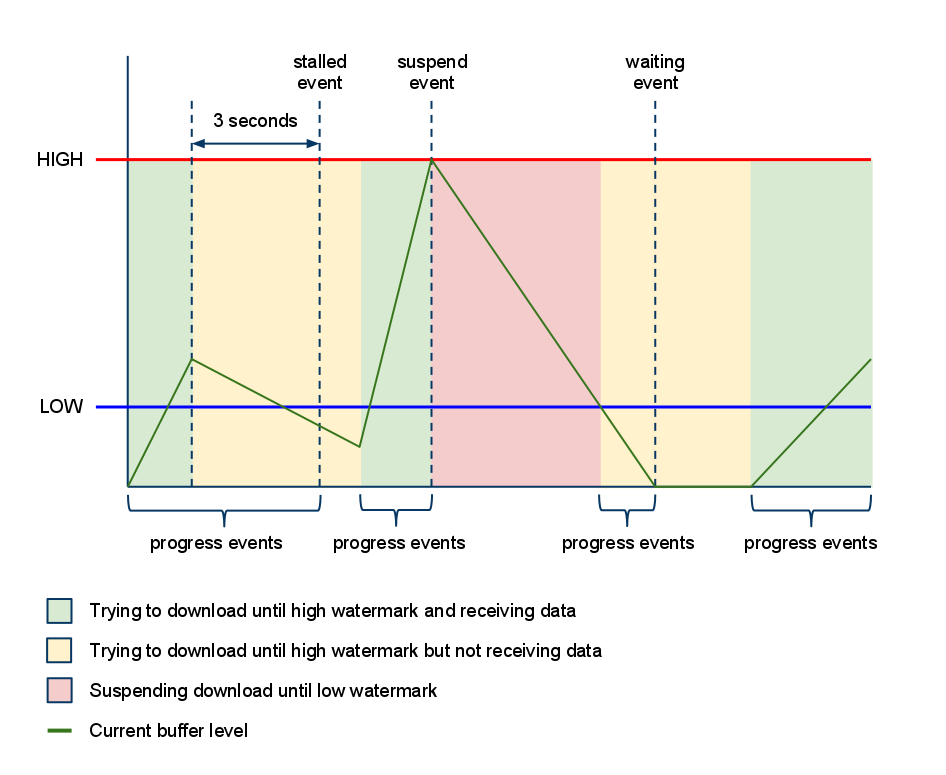
Chromium uses a combination of range requests and an in-memory sliding window to buffer media. We have a low and high watermark that is used to determine when to purposely stall the HTTP request and when to resume the HTTP request.
It's complicated, so here's a picture: