
Site Isolation Design Document
This design document covers technical information about how Site Isolation is built. For a general overview of Site Isolation, see https://www.chromium.org/Home/chromium-security/site-isolation.
Motivation
Chrome's multi-process architecture provides many benefits for speed, stability, and security. It allows web pages in unrelated tabs to run in parallel, and it allows users to continue using the browser and other tabs when a renderer process crashes. Because the renderer processes don't require direct access to disk, network, or devices, Chrome can also run them inside a restricted sandbox. This limits the damage that attackers can cause if they exploit a vulnerability in the renderer, including making it difficult for attackers to access the user's filesystem or devices, as well as privileged pages (e.g., settings or extensions) and pages in other profiles (e.g., Incognito mode).
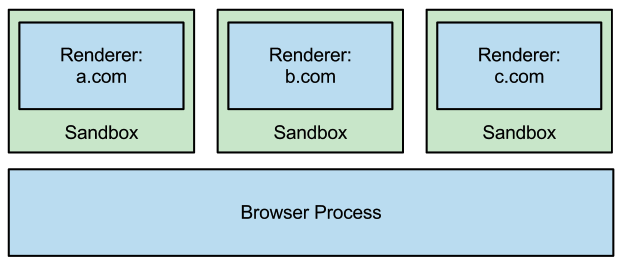
However, for a long time there was a large opportunity to use Chrome's sandbox for greater security benefits: isolating web sites from each other. Until version 67, Chrome made an effort to place pages from different web sites in different renderer processes when possible, but due to compatibility constraints, there were many cases in which pages from different sites share a process (e.g., cross-site iframes). In these cases, we used to rely on the renderer process to enforce the Same Origin Policy and keep web sites isolated from each other.
This page describes our "site isolation" efforts to improve Chrome to use sandboxed renderer processes as a security boundary between web sites, even in the presence of vulnerabilities in the renderer process. Our goal is to ensure a renderer process can be limited to contain pages from at most one web site. The browser process can then restrict that process's access to cookies and other resources, based on which web sites require dedicated processes.
Status: Site Isolation has been enabled by default on desktop platforms (for all sites) in Chrome 67, and on Android (for sites users log into) in Chrome 77. This helps defend against speculative side channel attacks (e.g., Spectre), and (on desktop) against UXSS and fully compromised renderer processes.
Threat Model
For a "one-site-per-process" security policy, we assume that an attacker can convince the user to visit a page that exploits a vulnerability in the renderer process, allowing the attacker to run arbitrary code within the sandbox. We also assume that an attacker may use speculative side channel attacks (e.g., Spectre) to read data within a renderer process. We focus on attackers that want to steal information or abuse privileges granted to other web sites.
Here, we use a precise definition for a site that we use as a principal: a page's site includes the scheme and registered domain name, including the public suffix, but ignoring subdomains, port, or path. We use sites instead of origins to avoid breaking compatibility with existing web pages that might modify their document.domain to communicate across subdomains.
We consider the following threats in scope for the proposed policy (once fully implemented):
- Stealing cross-site cookies and HTML5 stored data. We can prevent a renderer process from receiving cookies or stored data from sites other than its own.
- Stealing cross-site HTML, XML, and JSON data. Using MIME type and content sniffing, we can prevent a renderer process from loading most sensitive cross-site data. We cannot block all cross-site resources, however, because images, scripts, and other opaque files are permitted across sites.
- Stealing saved passwords. We can prevent a renderer process from receiving saved passwords from sites other than its own.
- Abusing permissions granted to another site. We can prevent a renderer process from using permissions such as geolocation that the user has granted to other sites.
- Compromising X-Frame-Options. We can prevent a renderer process from loading cross-site pages in iframes. This allows the browser process to decide if a given site can be loaded in an iframe or not based on X-Frame-Options or CSP frame-ancestors headers.
- Accessing cross-site DOM elements via UXSS bugs. An attacker exploiting a universal cross-site scripting bug in the renderer process will not be able to access DOM elements of cross-site pages, which will not live in the same renderer process.
We do not expect this policy to mitigate traditional cross-site attacks or attacks that occur within the page of a victim site, such as XSS, CSRF, XSSI, or clickjacking.
Requirements
To support a site-per-process policy in a multi-process web browser, we need to identify the smallest unit that cannot be split into multiple processes. This is not actually a single page, but rather a group of documents from the same web site that have references to each other. Such documents have full script access to each other's content, and they must run on a single thread, not concurrently. This group may span multiple frames or tabs, and they may come from multiple sub-domains of the same site.
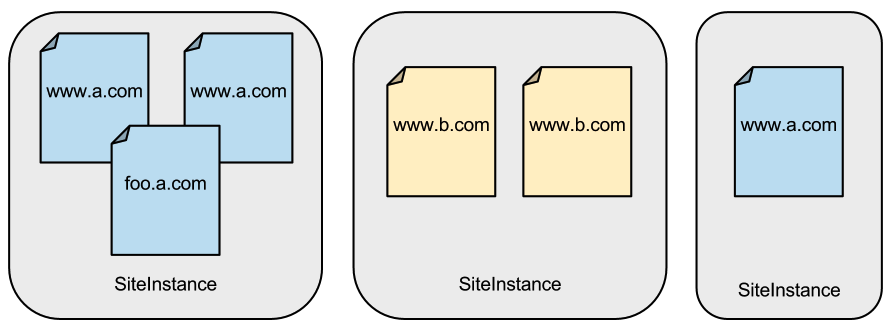
The HTML spec refers to this group as a "unit of related similar-origin browsing contexts." In Chrome, we refer to this as a SiteInstance. All of the documents within a SiteInstance may be able to script each other, and we must thus render them in the same process.
Note that a single tab might be navigated from one web site to another, and thus it may show different SiteInstances at different times. To support a site-per-process policy, a browser must be able to swap between renderer processes for these navigations.
There are also certain JavaScript interactions, such as postMessage() or close(), that are allowed between windows or frames even when they are showing documents from different sites. It is necessary to support these limited interactions between renderer processes.
In addition, top-level documents may contain iframes from different web sites. These iframes have their own security context and must be rendered in a process based on their own site, not the site of their parent frame.
Finally, it is important that sensitive cross-site data is not delivered to the renderer process, even if requested from contexts like image or script tags which normally work cross-site. This requires identifying which responses to allow and which to block.
Project Progression
As described on our Process Models page, there were originally several cases in which Chrome (prior to version 67) would place documents from different sites in the same renderer process. This kept Chrome compatible with existing web pages with cross-site iframes, at least until Site Isolation was enabled. Some examples of cross-site pages that shared a process at the time:
- Cross-site iframes were usually hosted in the same process as their parent document.
- Most renderer-initiated navigations (including link clicks, form submissions, and script navigations) were kept within the current process even if they cross a site boundary. This is because other windows in the same process could attempt to use postMessage or similar calls to interact with them.
- If too many renderer processes had been created, Chrome started to reuse existing processes rather than creating new ones. This reduces memory overhead.
However, at the time, Chrome already had taken many large steps towards site isolation. For example, it swapped renderer processes for cross-site navigations that were initiated in the browser process (such as omnibox navigations or bookmarks). Cross-origin JavaScript interactions were supported across processes, such as postMessage() and navigating another window. Chrome eventually gained support for out-of-process iframes in some contexts.
That early progress allowed us to use a stricter security policy for certain types of pages, such as privileged WebUI pages (like the Settings page). These pages are never allowed to share a process with regular web pages, even when navigating in a single tab. This is generally acceptable from a compatibility perspective because no scripting is expected between normal pages and WebUI pages, and because these can never be loaded in subframes of unprivileged pages.
As of Chrome 56, Chrome started using out-of-process iframes to keep web content out of privileged extension processes.
As of Chrome 63, Site Isolation could be enabled as an additional mitigation against universal cross-site scripting (UXSS) vulnerabilities and Spectre. It was also available via enterprise policy. That initial support was still in progress and had known issues and tradeoffs, but helped to defend against UXSS vulnerabilities and Spectre by putting pages from different sites in different processes to prevent leaks of cross-site data. The feature did not yet mitigate attacks with arbitrary remote code execution in the renderer process; this will later be possible as additional enforcements in the browser process are completed.
In Chrome 67, Site Isolation was enabled for all sites on desktop platforms (Windows, Mac, Linux, and ChromeOS), helping to defend against Spectre.
In Chrome 77, Site Isolation was also enabled on Android devices with at least 2 GB of RAM, but only for sites that users log into (to keep memory overhead lower). By this time, Site Isolation on desktop (i.e., with the full site-per-process policy) also defended against fully compromised renderer processes.
Project Tasks
To support a site-per-process policy in Chrome, we needed to complete the tasks outlined below. These ensure that cross-site navigations and script interactions will not break, despite having all pages from different sites in different processes. The master tracking bug is https://crbug.com/467770.
- Cross-Process Navigations Any navigation to a different web site requires a process swap in the current tab or frame. Status: Complete. Cross-process navigations are supported in all frames, and they are used for many cases: out-of-process iframes, keeping privileged WebUI or extension pages isolated from web pages, any cross-site main frame navigation, etc.
- Cross-Process JavaScript As mentioned above, some window and frame level interactions are allowed between pages from different sites. Common examples are postMessage, close, focus, blur, and assignments to window.location, notably excluding any access to page content. These interactions can generally be made asynchronous and can be implemented by passing messages to the appropriate renderer process. Status: Complete. Chrome supports all required interactions, including frame placeholders, postMessage, close, closed, focus, blur, and assignments to window.location between top-level windows in different processes.
- Out-of-Process iframes Iframes have separate security contexts from their parent document, so cross-site iframes must be rendered in a different process from their parent. It is also important that an iframe that is from the same origin as a popup window shares a process with the popup window and not its own parent page. We render these out-of-process iframes in a separate RenderFrame composited into the correct visual location, much like plugins. This is by far the largest requirement for supporting site-per-process, as it involves a major architecture change to the Chrome and Blink codebases. Status: Complete. The first uses of Out-of-Process iframes (OOPIFs) launched in Chrome 56, isolating extensions from web content. Widespread use for cross-site iframes launched in Chrome 67 on desktop, and in Chrome 77 for Android. Tracked at https://crbug.com/99379.
- Cross-Origin Read Blocking While any given site is allowed to request many types of cross-site resources (such as scripts and images), the browser process should prevent it from receiving cross-site HTML, XML, and JSON data (based on a combination of MIME type and content sniffing). Status: Complete. Our initial Cross-Site Document Blocking Policy design evolved into Cross-Origin Read Blocking (CORB), with a CORB Explainer. This was implemented for non-compromised renderer processes when Site Isolation is enabled as of Chrome 63, and for compromised renderers as of Chrome 77. The work was tracked at https://crbug.com/268640.
- Browser Process Enforcements Some of Chrome's security checks are performed in the renderer process. When a process is locked to a given site, the browser process can enforce many of these checks itself, limiting what a compromised renderer process can achieve in an attack. This includes attempts to access site specific stored data and permissions, as well as other attempts to lie to the browser process. Status: Most enforcements are in place, though more are tracked in https://crbug.com/786673.
- Improved Renderer Process Limit Policy We have investigated ways to limit number of extra processes Chrome creates in Site Isolation modes. One option is to support modes that only isolate a set of origins or sites (i.e., --isolate-origins) rather than all sites (i.e., --site-per-process). However, we are currently leaning towards isolating all sites given our current findings. Note that a page from one site may reuse a process that has already been used for that same site, and we aggressively reuse processes in this way for subframes when possible. Processes will not be reused for cross-site pages. Status: On desktop, we isolate all sites, allowing process reuse only for pages from the same site. On Android, only a subset of sites end up in dedicated processes.
Performance
Monitoring the performance impact of Site Isolation on Chrome has been a critical part of this effort. Site Isolation can affect performance in several ways, both positive and negative: some frames may render faster by running in parallel with the rest of the page, but creating additional renderer processes also increases memory requirements and may introduce latency on cross-process navigations. We are taking several steps to minimize the costs incurred, and we are using metrics collected from actual browsing data to measure the impact.
As mentioned above under "Renderer Process Limit Policy," we investigated one option for reducing the number of processes by isolating only a subset of web sites. In such a mode, most web sites would continue to use Chrome's old process model, while web sites that users are likely to log into would be isolated. However, we are currently aiming to isolate all sites if possible, based on current performance measurements, simplicity, and the extra protection it offers.
Our evaluation is described in our USENIX Security 2019 paper: Site Isolation: Process Separation for Web Sites within the Browser.
How to Enable
See this Site Isolation Overview page for more details on how to enable or configure Site Isolation. In most cases, no action is necessary.
Development Resources
Updating Chrome Features:
Build Status:
- Site Isolation FYI bots: Linux and Windows
- Site Isolation try bot: linux_site_isolation
2015 Site Isolation Summit Talks
Talks and discussion from January 2015.
Site Isolation Overview
Site Isolation Overview
Chromium Changes for OOPIF
Chromium Changes for OOPIF
Blink Changes for OOPIF
Blink Changes for OOPIF
Discussions/Questions
The mailing list for technical discussions on Site Isolation is site-isolation-dev@chromium.org.